Basic HTML Version


3
“When my father purchased our first Angus females
in the spring of 1952, I am sure his goal that day did not
involve the journey our family has taken over the past 50
years,” said the late Joe Reznicek in 2002. Certainly, no
one could have predicted the untimely ending to the
journey of which Joe spoke. From his early days on his
family farm in Illinois, to the Sandhills of Nebraska operat-
ing Reznicek Farms, to his entry in the Brangus seedstock
business in the1980s, to managing and eventually own-
ing Cow Creek Ranch, Joe Reznicek's premature passing
in 2010 left behind both a legacy in the beef cattle busi-
ness and a gift of one of the most renowned and interna-
tionally recognized registered Brangus herds in the U.S.,
Cow Creek Ranch.
Victory is seldom achieved by playing it safe. On the
contrary, victory is won by those who step outside the
box and change the way the game is played. Such was
the philosophy of North Carolina businessman, G. Allen
Mebane, who in 1985 established Cow Creek Ranch in
North Carolina by moving the original Cow Creek herd
from Texas. During Mebane's early years in the Brangus
breed much of the attraction and excitement was creat-
ed by successful businessmen who used the existing tax
code to their advantage. Breeders bought and sold cattle
for costly money while hosting elaborate Brangus sales
with parties and entertainers.
But Mebane hardly fit the stereotype of a business-
man running a company at a loss to pursue an expensive
hobby of raising purebred Brangus cattle. Through a
chance meeting, Mebane met Joe Reznicek and chose
him to help capitalize on his cow investment and to build
a viable cattle enterprise that would be based on cow
function and profitability. Joe began applying core princi-
ples of creating a functional, efficient cow herd.What
happened over the succeeding 25 years was the evolu-
tion of a powerful, forage-based cow herd and creation
of one of the leading and most innovative seedstock
operations in the country.
Early on, Reznicek made two intensely profound decisions
that
would eventually drive the direction of the Cow Creek
Ranch program. The first occurred in July 1985 when Cow
Creek Ranch harvested a test group of purebred Brangus
steers, a practice rarely done at the time.“The business
side of Allen kept preaching quality control. So we tested
our product,” said Joe. Eye-opening data showed the
Brangus steers’ ribeyes to be about the size of pork chops.
Harvest results convinced Joe and Allen that their train
was running down the wrong track, even though their
genetics were perceived as among the top of the breed.
The carcass data prompted Cow Creek Ranch to add first
generation Brangus sire, Pathfinder 152W (Pathfinder), to
their
program.
Reznicek
then made a
bold move
of breeding
every Cow
Creek Ranch
cow to
Pathfinder,
an unproven,
new genetics
yearling bull.
The gamble
paid off and
Pathfinder
would become
the cornerstone
of the Cow
Creek Ranch
program. To further advance their mission, Joe and Allen
brought in a herd of Reznicek Angus cattle to experiment
with producing new Brangus genetics. Second genera-
tion sire, VCC Impact 92T17, was also added to improve
the herd's feet and leg soundness. During this era, Cow
Creek Ranch aggressively shifted their genetic direction
and began addressing the breed's absence of carcass
traits. To measure their progress, Cow Creek Ranch began
using ultrasound technology on yearling bulls in 1988.
While a timely, but significant, genetic transformation was tak-
ing place
, Reznicek was uncomfortable with the fact that
the prominent genetics in the Brangus breed required
too much delivered feed to maintain productivity. To
make Cow Creek Ranch a profitable enterprise, Reznicek
knew he'd have to rely on Mother Nature and begin
developing a forage-based herd of cattle focused on pro-
duction efficiency.
“I learned early on to let a cow stay as close to nature
and to use nature in the culling process,” Joe recalled in
2002.“I learned to respect what that mama cow and
nature are telling you. I learned how much you could see
from horseback trailing a cow herd. From atop a horse
you see cows that are free moving on their feet and legs
and the structural difference in the ones that don't stride
out.” Joe noted.“You can actually see the muscle and
bone structure and how it works in harmony to make
that critter functional.” He knew nature had to take care
of the cow herd, not a feed wagon.
The next move Joe made would be one that would
become the most powerful driver of Cow Creek Ranch
continued on next page
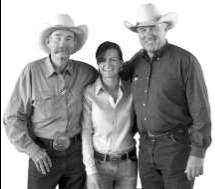
Joe Reznicek, left, had a deep passion for the
land and cattle business. He was a visionary
and once said,“To be a good cattleman, you
have to feel the soil.” Photo from 2008 Cow
Creek Ranch sale, Joe’s last, with his wife, Joy,
and friend, Baxter Black.
Cow Creek Ranch Leaves
Legacy in Beef Cattle Industry