81
Ron Bieber
In July of 1961, my brother Leroy Bieber and I were looking for a place to produce good beef cattle.
We purchased Julius Binder’s and Frank Sieh’s properties amounting to 2300 acres. In September of that
year, I was called into the Army because of the Cuban missile crisis. While serving for ten months, Leroy
and I purchased some available land from Jacob Jakober. This expanded our operation to 3600 acres.
In the spring of 1962, we began tagging all cows and calves and started keeping weaning weight
records. At that time, we were calving mostly Hereford cows bred to Hereford bulls. We also had a
group of baldy calves that produced 60 pounds more than the Herefords. In 1964, Leroy and I split up
our operations, and Leroy purchased a farmstead three miles west of our operation. In the late winter
Lois and I purchased our first Shorthorn bull from Fred Kiesz.
March of 1966 brought a tremendous blizzard our way. By the time we got out to find the cattle,
some were four feet below the snow and still alive. We pulled them out, rolled them on to a toboggan
and pulled them home. We lost 30 Hereford cows, but were able to buy 35 Shorthorn cows later that
spring that were bred to a polled Hereford bull. This led to progress in converting our entire cow herd
to crossbred cattle. Soon we realized that systematic crossbreeding would result in superior weights,
and our weaning weights went from 380 to 560 pounds in a period of ten years. Crossbred cows elimi-
nated pinkeye, cancer eye and prolaspe, and we consistently had better breed back.
In September of 1967, I decided that we would take a working vacation and go to Montana to search for the next cross on our cow herd.
Our first stop was at Miles City to have a look at the USDA cattle research station, where an acquaintance had had success using
Line 1 Herefords. Next, we took in the Montana Hereford tour, looking at numerous herds and meeting with lots of Hereford breeders.
When I said we were considering using Red Angus, one of the Hereford breeders from western North Dakota said, “Red Angus are like
women’s hats—here today, gone tomorrow.” Twenty years later he started using Red Angus, and he no longer produces Herefords.
In October of 1968, I saw an ad in the Western Livestock Reporter for the sale of 50 registered Red Angus cows in May, Idaho. When
I arrived, Gene Cook took me around for a tour of his Red Angus herd. I selected 14 cows, which Gene had transported by a pot that
was filled with feeder cattle headed to our area. The cows arrived in early December, and we were officially a Red Angus seedstock
herd.
April of 1969 brought an opportunity to take another trip to Montana. Ora Erdma-
nn from Erdmann Angus had sent ten bulls to the Stanford Bull Test Station in north-
west Montana. The test had 300 or more Angus, Hereford, Shorthorn and Red Angus
bulls, as I remember. Early one morning I fed the cattle and tagged new calves. I
finished seeding the field east of the house. Ora Erdmann showed up just before
noon, and with him was Dr. Harlan Ritchie, Animal Science professor from Michigan
State University.
I loaded my bag in the single cab two-ton truck, and off we went to Montana:
three men, luggage and lots of BS. The major conversation topics were cattle and
genetics. It didn’t take many miles down the road before we were engaged in an
intense conversation concerning cattle breeding. After he found out we were using a
good Shorthorn bull, Harlan said that there was a breeder in Michigan he knew who
was interested in a large framed Shorthorn bull like we had. It turned out Harlan was
not coming back with Ora and myself, so an op-portunity to sell a high dollar herd sire was missed. Harlan is a very astute observer of
animal breeding and has been known for years as a leading authority on cattle breeding. Ora Erdmann was in his 60s, a keen observer
of cattle and a self-taught cattle breeder. His famous one-liner was “I don’t want Shetland pony Angus.”
In the late 1960s the beef cattle industry was changing rapidly. Suddenly performance records became important, and many
cattlemen were looking for larger framed cattle. The pursuit of more frame and the introduction of continental breeds was recognized
by keen observers of cattle breeding, like Harlan Ritchie, who realized frame could be detrimental to profitable beef production. That
trip to Montana enlightened me and gave us contact with many leading cattle breeders in the beef industry.
In September of 1969, R.C. Buckner of Tyler, Texas, was having a Red Angus dispersion sale. Albert Erdmann and I made the trip
in a two-ton truck to watch Buckner sell off 750 head of cattle. When we left, we ended up filling the truck with 20 head. After that, every
chance we had we acquired more Red Angus cows and heifers. Soon our herd numbered 250 breeding females. In the fall of 1975, we
sold our crossbred herd to Henderson Ranch of Lodgepole, South Dakota.
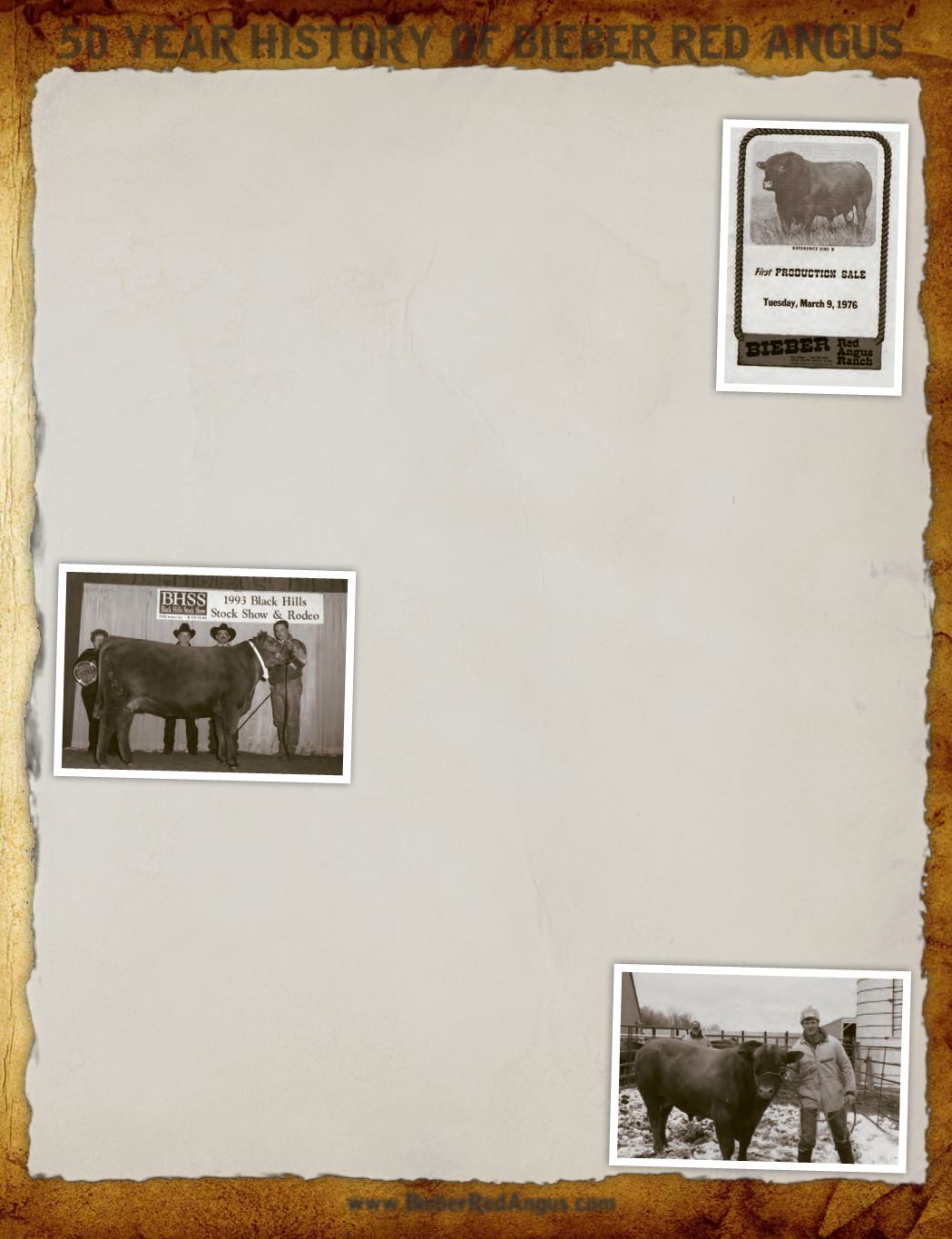
In 1975, we also had difficulty selling bulls, so we made the decision to have a
production sale. That May we moved enough soil to form a level spot to put up an insu-
lated Morton building. In those early years we provided information on birth weight,
weaning weight, yearling weight and gain from weaning to yearling at each sale.
Now we provide 12 EPDs and nine weights and measurements.
In the spring of 1983, we purchased the West Ranch from Harold Geffre. In the
spring of 1988, we were able to purchase 800 acres from the Morrison Brothers, land
that had run along the west side of our property. Then in the winter of 1989, we were
offered the Jonathan Brenise place, which was 480 acres. We presently have enough
land to run 800 cows.
50 YEAR HISTORY OF BIEBER RED ANGUS


